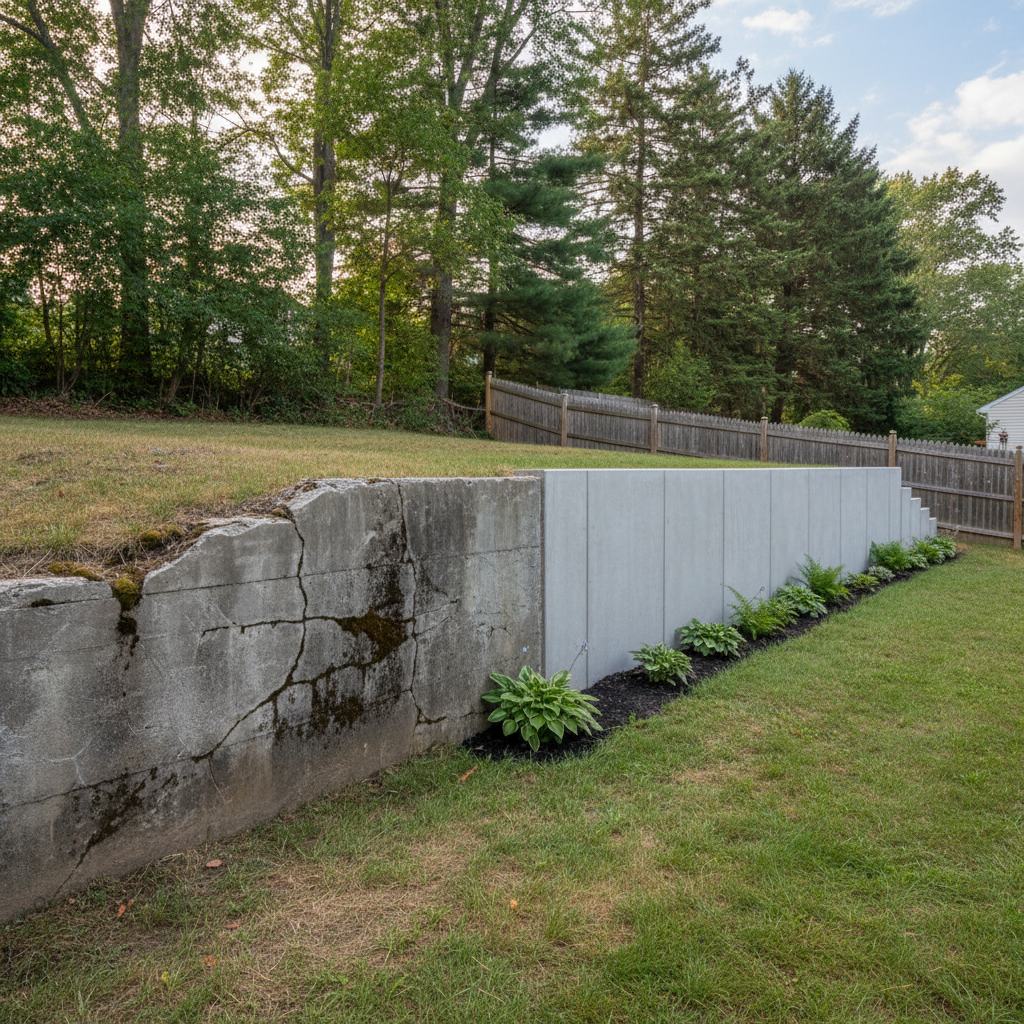
So, you need a retaining wall. Maybe your yard's got a slope that's washing away, or you're trying to reclaim some usable space. Good for you for thinking about it, because a well-built retaining wall isn't just about looks; it's about protecting your property and making it more functional. Now, when it comes to concrete, you've generally got two main ways to go: poured-in-place concrete or segmental concrete block walls. Both have their place, but let's talk about what I've seen work best right here in Worcester.
Poured Concrete Retaining Walls: The Unsung Hero
When I talk about poured concrete, I mean we build a form, put in steel rebar for reinforcement, and then pour liquid concrete directly into that form. Once it cures, you've got one solid, monolithic structure. Think of it like a miniature version of a bridge abutment or a foundation wall.
Durability & Strength: This is where poured concrete really shines, especially for us here in Central Mass. Our freeze-thaw cycles are brutal, right? A solid, reinforced poured wall stands up to that expansion and contraction better than almost anything. It's incredibly strong, designed to handle significant earth pressure, and when done right, it's going to last for generations. I've seen poured walls in older parts of Worcester, like around Tatnuck or Salisbury Street, that are still doing their job perfectly after 50, 60, even 70 years.
Maintenance: Practically none. Once it's in, it's in. You might want to clean it occasionally if you're particular about appearance, but structurally, it's a set-it-and-forget-it solution. No individual blocks to shift or settle.
Appearance: This is often where people think poured concrete falls short, but that's not always true anymore. You can get different textures and finishes on the forms, or even veneer it with stone or brick after the fact. It's a clean, strong look, and if you're going for a modern or industrial aesthetic, it's perfect as is. For a more traditional look, a good mason can add a stone facade that'll make it blend right in.
Cost: Generally, poured concrete walls tend to have a higher upfront cost per linear foot than block walls. The labor for forming, rebar placement, and the concrete itself can add up. However, when you consider the longevity and zero maintenance, the long-term value is often superior.
Segmental Concrete Block Retaining Walls: The Popular Choice
These are the walls you see everywhere. They're made from individual, interlocking concrete blocks, often with a lip or pin system that helps them stack and hold together. They rely on their own weight and the interlock to resist the earth's pressure.
Durability & Strength: For smaller, decorative walls or those holding back minimal soil, they're perfectly fine. They're designed to be flexible, which can be an advantage in some soil conditions. However, for taller walls or those under significant load, especially with our clay-heavy soils in Worcester that can get saturated and heavy, I've seen issues. Individual blocks can shift, settle unevenly, or even crack over time due to frost heave if the base isn't absolutely perfect and deep enough.
Maintenance: More than poured concrete. You might find yourself resetting individual blocks that have shifted, or dealing with weeds growing in the gaps. While they're generally low maintenance, they're not maintenance-free.
Appearance: This is their big selling point for many homeowners. They come in a huge variety of colors, textures, and styles, mimicking natural stone or brick. They can look fantastic and blend well with landscaping. If you're looking for a specific aesthetic without the added cost of a full stone veneer, block walls offer a lot of options.
Cost: Typically, segmental block walls are less expensive to install initially than poured concrete. The blocks are mass-produced, and the installation process can be quicker for smaller walls, requiring less specialized equipment than pouring concrete.
My Takeaway for Worcester Homeowners
Look, both options have their merits. If you've got a small, decorative garden wall that's only a couple of feet high and not holding back a lot of pressure, a well-installed segmental block wall can look great and do the job. It's often a good choice for DIYers too, though I always recommend a professional for anything structural.
But if you're talking about a serious retaining wall – something over three feet tall, holding back a significant slope, or supporting a driveway or patio – my recommendation, hands down, is a poured concrete wall. Especially here in Worcester, where we deal with heavy snow, significant rainfall, and those relentless freeze-thaw cycles that can wreak havoc on less robust structures. The strength, stability, and sheer longevity of a properly engineered and poured concrete wall simply can't be beaten.
It's an investment, sure, but it's one that pays off in decades of reliable performance. You build it once, you build it right, and you don't have to worry about it again. That's the kind of quality we stand by at Worcester Concrete Precision. We've seen what works and what doesn't in this city, and when it comes to holding back the earth, solid concrete is king.